Monte
Carlo Simulation
“House
Construction”
Author: Pat Dotson
The objective of this project is determining the amount of
time required to construct a new home using Monte Carlo Simulation. Monte
Carlo Simulation is a mathematical technique for numerically
solving differential equations. Monte Carlo Simulation is usually used to solve
a problem that requires one or more statistics of a probability distribution be
calculated. The Monte Carlo Simulation calculates multiple scenarios of a model
by repeatedly sampling values from the probability distributions for the
uncertain variables and using those values. The completion date of home is a
necessary component for the home builder. The home builder needs the completion
date for several reasons:
- The
customer purchasing the home wants a move in date that is specific.
- The
home builder needs a specific completion date to calculate the
construction interest required for the new home.
- The
home builder knows how much working capital is tied up in each home and by
having a specific completion date; the home builder will know the specific
date when the working capital will be available for new projects.
Using Monte Carlo Simulation, the home builder will know within
a certain probability level, the expected completion date of the new home.
The following list is the variables required to compute the
house completion date. For each work stage, the expected completion time is
entered. The expected completion date is either days to complete as bid by the
sub-contractor or the days to complete the work stage is based on previous
experience constructing a house of similar size and features. The most
optimistic days to complete work stage would reduce the expected by 15% and the
pessimistic days to complete would be 40% greater than the expected days to
complete. In house construction, it is typical that a project will take a
higher percentage to run over the expected time than the percentage to reduce
the completion time. To view the inputs for this model click on the following
link:
Duration
Model
|
Variable
|
Days
to Complete Work Stage
|
|
Work Stages
|
Optimistic
|
Expected
|
Pessimistic
|
|
Plans
|
1.7
|
2
|
2.8
|
|
Site
Plan Survey
|
3.4
|
4
|
5.6
|
|
Permits
|
3.4
|
4
|
5.6
|
|
Site
Work
|
8.5
|
10
|
14
|
|
Foundation
|
5.95
|
7
|
9.8
|
|
Plumbing
- Slab
|
2.55
|
3
|
4.2
|
|
Survey
- Foundation
|
3.4
|
4
|
5.6
|
|
Waterproofing
|
0.85
|
1
|
1.4
|
|
Grading
Backfill
|
1.7
|
2
|
2.8
|
|
Gravel
Basement
|
0.85
|
1
|
1.4
|
|
Termite
Protection
|
0.85
|
1
|
1.4
|
|
Basement
Slab
|
2.55
|
3
|
4.2
|
|
Framing
|
8.5
|
10
|
14
|
|
Fireplace-
Rough
|
0.85
|
1
|
1.4
|
|
Roofing/Shingles
|
1.7
|
2
|
2.8
|
|
Plumbing-
Rough
|
3.4
|
4
|
5.6
|
|
HVAC - Rough
|
4.25
|
5
|
7
|
|
Exterior
Trim/Siding
|
4.25
|
5
|
7
|
|
Windows &
Doors
|
1.7
|
2
|
2.8
|
|
Steel-Brick
|
0.85
|
1
|
1.4
|
|
Electrical -
Rough
|
2.55
|
3
|
4.2
|
|
Prime Exterior
|
0.85
|
1
|
1.4
|
|
Masonry
|
8.5
|
10
|
14
|
|
Security -
Rough
|
0.85
|
1
|
1.4
|
|
General Site
Cleanup
|
0.85
|
1
|
1.4
|
|
Insulation -
Batts
|
0.85
|
1
|
1.4
|
|
Sewer Line
|
2.55
|
3
|
4.2
|
|
Utility
Connections
|
4.25
|
5
|
7
|
|
Brick Clean
|
0.85
|
1
|
1.4
|
|
Drywall
|
6.8
|
8
|
11.2
|
|
Water Line
|
0.85
|
1
|
1.4
|
|
Roofing
-Flashing
|
0.85
|
1
|
1.4
|
|
Shutters
|
0.85
|
1
|
1.4
|
|
Grading -
Final
|
1.7
|
2
|
2.8
|
|
Driveway
|
4.25
|
5
|
7
|
|
Guttering
|
1.7
|
2
|
2.8
|
|
Deck
|
0.85
|
1
|
1.4
|
|
Wrought
Iron Railing
|
0.85
|
1
|
1.4
|
|
Fireplace
-Final
|
0.85
|
1
|
1.4
|
|
Hardwood
Flooring
|
1.7
|
2
|
2.8
|
|
Cabinets
& Vanities
|
0.85
|
1
|
1.4
|
|
Interior Trim
|
4.25
|
5
|
7
|
|
Marble Tops
|
0.85
|
1
|
1.4
|
|
Ceramic Tile
|
1.7
|
2
|
2.8
|
|
Garage Doors
|
0.85
|
1
|
1.4
|
|
Painting -
Exterior
|
1.7
|
2
|
2.8
|
|
Painting -
Interior
|
4.25
|
5
|
7
|
|
HVAC - Final
|
1.7
|
2
|
2.8
|
|
Hardware -
Interior
|
0.85
|
1
|
1.4
|
|
Clean -
Windows
|
0.85
|
1
|
1.4
|
|
Plumbing -
Final
|
1.7
|
2
|
2.8
|
|
Appliances
|
0.85
|
1
|
1.4
|
|
Light
Fixtures
|
0.85
|
1
|
1.4
|
|
Electrical -
Final
|
2.55
|
3
|
4.2
|
|
Security -
Final
|
0.85
|
1
|
1.4
|
|
Insulation -
Blown
|
0.85
|
1
|
1.4
|
|
Landscaping
|
2.55
|
3
|
4.2
|
|
Survey -
Final
|
0.85
|
1
|
1.4
|
|
Wallpaper
|
1.7
|
2
|
2.8
|
|
Hardwood
Flooring
|
3.4
|
4
|
5.6
|
|
Mirrors
|
0.85
|
1
|
1.4
|
|
Shower
Enclosures
|
0.85
|
1
|
1.4
|
|
Flooring -
Carpet
|
0.85
|
1
|
1.4
|
|
Flooring -
Vinyl
|
0.85
|
1
|
1.4
|
|
Trim - Punch
Outs
|
0.85
|
1
|
1.4
|
|
Cleanup - Pre-Final
|
0.85
|
1
|
1.4
|
|
Paint - Touch
Ups
|
2.55
|
3
|
4.2
|
|
Power Wash Exterior
|
0.85
|
1
|
1.4
|
|
Clean - Final
|
0.85
|
1
|
1.4
|
|
Punch List
Items
|
4.25
|
5
|
7
|
The influence diagram for this project is very intensive.
Each activity or work stage in the process is connected to previous work
stages. For example, the framing stage must be completed prior to starting of
the roofing stage. To see the influence diagram for this project, click on the
following link:
Critical Path
for New Home Construction
:
The following chart is a snap shot of the summary statistics
for the simulation. The calculation to the right of each work stage represents
whether or not the work stage is critical to the completion date of the house.
If the results are a 1, then the work stage is said to always be critical, if
the result is 0.501 as reflected in the Steel-Brick Stage, then the work stage
is said to be critical 50.1% of the time. To view the simulation results of
this model click on the following link: Simulation
Results
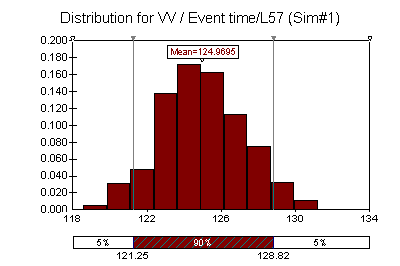
The following graph shows a histogram from simulation number
one. One simulation was run for each work stage. The following output graph
shows that the house can be completed between 121.25 and 128.82 days with a 90%
confidence level.
This could use much improvement. In reality, most work
stages can begin before their predecessor is completed. For example, the HVAC
rough-in stage can begin two days after the plumbing work stage has begun. By
starting before the previous stage has begun, the amount of days to complete
the project would be greatly reduced. To improve this model, the expected start
times must be implemented so that stages can start at their earliest possible
date. The model must also consider external factors outside the control of the
home builder. The weather is a variable that the builder cannot control. This
variable needs to be implemented into the model to calculate the number of days
to complete the house correctly.